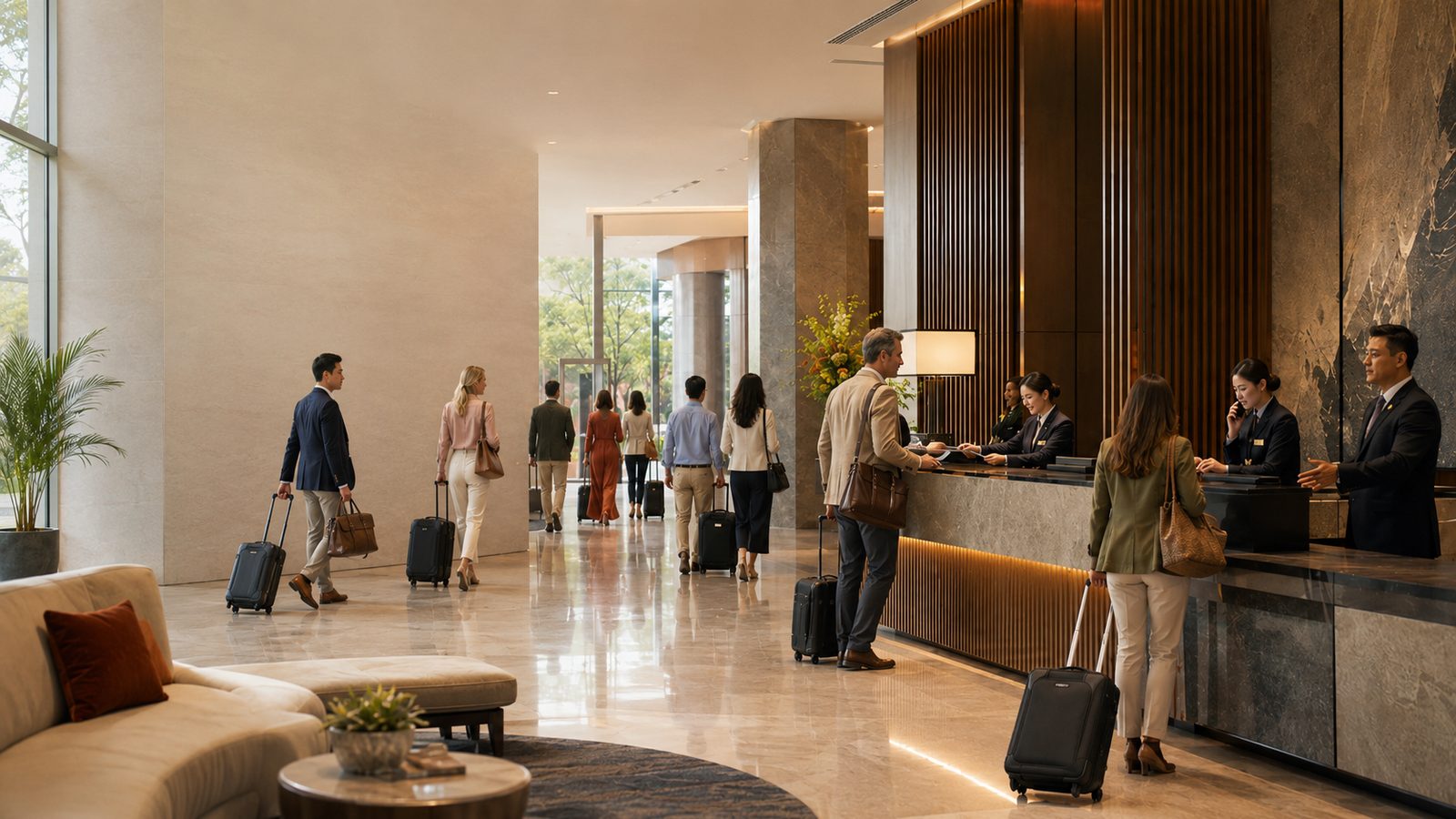
The gap between an Airbnb-style let and a professionally managed hotel is not a product difference. It is a management difference — and it is large.
Transactional Airbnb-style lets in Johor Bahru run at 29–45% occupancy. Independent managed hotels sit around 55%. Branded, internationally managed hotels reach 72–76%. That 29–45% → 72–76% jump is not a product difference — it is a management difference, built from distribution, corporate accounts, MICE and loyalty reach an owner cannot replicate. Choosing the operator is the highest-leverage decision an investor makes after location.
Hospitality Capital analysisRead the analysis
About this publication
Independent intelligence on Malaysian hospitality investment.
News, data and analysis on the Kuala Lumpur and Johor Bahru hotel markets, written for investors in Singapore, Hong Kong and Taiwan. Independent editorial; any commercial relationship is labelled on the page where it applies.
Articles published
40
Named sources cited
55
Publisher profiles
15
Markets covered
KL · JB
Every figure sourced · every original report linked
Malaysia Hospitality Investment Brief
Hotel-investment news and analysis from KL and Johor Bahru, by email. Free.
We curate the reporting. We verify the claims. We explain what it means for investors.
We monitor established news organisations, government agencies, stock-exchange filings and recognised research consultancies. Every article links to its original sources, distinguishes verified facts from claims and clearly labels promotional material.
Publisher names, logos and trademarks belong to their respective owners. Hospitality Capital Malaysia cites and summarises their reporting with attribution. Inclusion does not imply affiliation, sponsorship or endorsement.
Johor has only nine operating five-star hotels — about 14.5% of its 3-to-5-star room supply — even as five-star occupancy jumped to 61.7% in 1Q2026 from 52.0% a year earlier, on 6.1 million visitor arrivals (77.4% from Singapore), according to Knight Frank's Real Estate Highlights 1H2026. The state's hospitality market is dominated by mid-scale stock, and its lower tier is being squeezed by Airbnb and homestays — leaving a clear opening for professionally managed premium hotels.
Read by price per room — the standard way to compare hotel value — recent Kuala Lumpur transactions show prime central assets clearing RM1.8 to RM2.5 million per key, several times what suburban and Putrajaya hotels fetch. A five-star luxury hotel on Jalan Ampang is carried at about RM2.48 million per room; a 55-suite ultra-luxury hotel in the KLCC precinct was acquired by a listed REIT at roughly RM2.55 million a key. The variable that separates them from RM430,000-per-key suburban stock is not the star rating. It is location.
From 1 January 2026, Johor levies an RM3-per-night hotel tax under its new Hotel Enactment 2025. The tax itself is negligible. The part investors should read is buried alongside it: the same law grants Johor stronger enforcement powers against unlicensed hotels and non-compliant establishments — a quiet tightening that works against the informal short-let operators and in favour of licensed, professionally managed hotels.
Occupancy, ADR, RevPAR, hotel supply and visitor-arrival series for both markets, each figure tied to a named source. The dashboards are in development and will publish one verified series at a time.
Kuala Lumpur luxury-hotel RevPAR ran 5.7% higher year-to-date March 2026 than the same period in 2024, on a 3.4-percentage-point occupancy gain, according to JLL — with the segment now 22.7% above 2019 levels. It comes as 2,641 rooms enter the market in 2026 (Waldorf Astoria, Regent, Conrad) within a ~4,600-room 2026–2028 pipeline weighted 60% to luxury. Rising performance into rising supply is the combination investors want to see.
Johor's residential transaction value rose 19.5% year on year to RM24.4 billion in Q3 2025 — 86% of the entire 2024 total in just three quarters — even as transaction volume held flat, according to the Olive Tree Property Consultants monitor published by The Edge. Serviced-apartment prices rose 2.5–6.7% and rents climbed, on RM91.1 billion of cumulative approved investment. A high-rise supply overhang remains the caveat, but the value trend is unmistakably up.
Singapore's Immigration & Checkpoints Authority recorded a daily average above 525,000 travellers across the Woodlands and Tuas land checkpoints during the June 2025 school holidays — about 10% up on 2024 — and a single-day record of more than 578,000 crossings on 20 June 2025. This is the official measure of the cross-border flow that every Johor Bahru hospitality thesis draws on, and it is growing before the RTS Link even opens.
Johor drew roughly 11 million Singapore visitors in the first seven months of 2025, who spent an estimated S$1 billion, according to state figures compiled by The Independent Singapore — with DBS reporting a 30% year-on-year rise in ringgit spending among its clients and UOB card data showing Singaporean dining spend in Johor Bahru up 40%. For hospitality investors, this is the footfall thesis moving from projection to measured behaviour.
Curated news
For the cross-border investor
Malaysia hotel investing, viewed from Singapore
Currency exposure, ownership rules, acquisition costs and the RTS Link — the questions that decide whether a Malaysian hospitality asset makes sense from across the Causeway.
Johor has only nine operating five-star hotels — about 14.5% of its 3-to-5-star room supply — even as five-star occupancy jumped to 61.7% in 1Q2026 from 52.0% a year earlier, on 6.1 million visitor arrivals (77.4% from Singapore), according to Knight Frank's Real Estate Highlights 1H2026. The state's hospitality market is dominated by mid-scale stock, and its lower tier is being squeezed by Airbnb and homestays — leaving a clear opening for professionally managed premium hotels.
When China designated Shenzhen a special economic zone in 1980, it was a border town of about 30,000 people beside wealthy, expensive Hong Kong. Capital and industry crossed the border; today Shenzhen has around 18 million people, one of China's highest GDP-per-capita figures, and is home to Huawei, Tencent and BYD. Singapore–Johor is not Shenzhen, and this is a pattern reference, not a price forecast — but the mechanism is the same, and in one respect Johor's is cleaner.
Johor's residential transaction value rose 19.5% year on year to RM24.4 billion in Q3 2025 — 86% of the entire 2024 total in just three quarters — even as transaction volume held flat, according to the Olive Tree Property Consultants monitor published by The Edge. Serviced-apartment prices rose 2.5–6.7% and rents climbed, on RM91.1 billion of cumulative approved investment. A high-rise supply overhang remains the caveat, but the value trend is unmistakably up.
Singapore's Immigration & Checkpoints Authority recorded a daily average above 525,000 travellers across the Woodlands and Tuas land checkpoints during the June 2025 school holidays — about 10% up on 2024 — and a single-day record of more than 578,000 crossings on 20 June 2025. This is the official measure of the cross-border flow that every Johor Bahru hospitality thesis draws on, and it is growing before the RTS Link even opens.
· 4 min read
Start here
Investor guides
How hotel investment actually works — the structures, the fees and the questions worth asking before anyone shows you a brochure.
Transactional Airbnb-style lets in Johor Bahru run at 29–45% occupancy. Independent managed hotels sit around 55%. Branded, internationally managed hotels reach 72–76%. That 29–45% → 72–76% jump is not a product difference — it is a management difference, built from distribution, corporate accounts, MICE and loyalty reach an owner cannot replicate. Choosing the operator is the highest-leverage decision an investor makes after location.
Structured reviews of Malaysian hotel suites, branded residences and managed hospitality products — location, operator, ownership structure, fees, risks and exit — separating verified facts from developer claims. The first reviews are being prepared against primary documents.